

Words and Photograph By: John Roapes
Entry #1.0: Introductory Remarks
Recently, a mysterious book giveaway took place within two miles of my house. I was among the very first to show. Rather, I should say, it was my wife, a mutual friend of ours (who happens to be French and an artist herself, and as such still practices the sacred art of reading) and Me that morning. The “BOOK Giveaway” was mysterious (but not necessarily Nefarious) because the books were all, it seemed, retired library books of one sort or another, varied across every possible genre, as if they were a microcosm of the entire library from which they’d been acquired.
There is likely nothing mysterious about it at all. Another library branch closed, I’m sure. The books had to go somewhere — and those bastard children that did not find a library in need were on the precipice of being sent off on a raft to cross the River Styx — that is if my wife, our friend, and I did not come and take as many as we could fit into our respective modes of transportation. Several boxes’ full for me. My wife took away a collection equally as ambitious. And M, our friend, had scooped up everything else that was literature. We left behind a carcass: piles of trade paperbacks by Nora Roberts, James Patterson, Bill O’Reily, and a few dozen other authors who at one time or another occupied a spot on the racks at an airport bookshop.
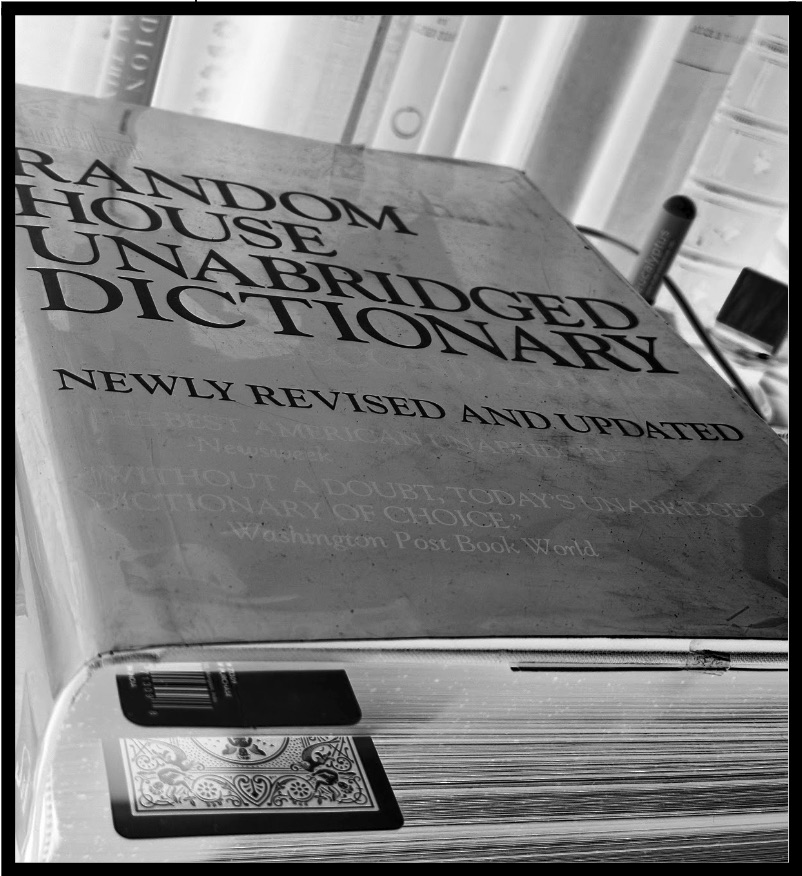
One of the books I took away was The Random House Unabridged English Dictionary, 2nd Edition – printed approximately around the time physical books started their rapid tailspin into vestigial artifacts, nostalgia, aesthetic objects worth only what value they served as conversation starters when placed on a bookshelf or coffee table—I’m talking about the year 1993.
It had originally been sold with a CD-ROM, that I unfortunately could not find, but likely wouldn’t have had the capacity to store the contents of the book in text format on a single disc, if I had to guess. I wonder now, what it was for – note to self: research topic.
It is, without question and by a significant margin, the largest book I own, roughly the size of a cinder block (with slightly distorted dimensions); not so much of a door stop as a door step. It reaches the outer limits of an individual book’s spinal possibilities: the literary equivalent of Andre the Giant. When we came home that morning I had to make a final trip to the car and back for just the one book. Just cartoonishly large.
And yet, observing the simple exterior we know there is nothing funny about it. It is No Joke. the simultaneously dated and yet timeless font used for the title, the down-to-business nature of its first few pages which are immediately filled to the brim with tables of letters and figures and all varieties of punctuation marks—it isn’t goofy at all. This is a book that means business. Or meant business back in ’93. It is the maximalist vision of pre-digital efficiency. A whole world in one book. Not the Absurdity of 30 or so volumes that make up the Encyclopedia Britannica,
just the Words, all the Words, in detail, completely UNABRIDGED.
After 2,478, the page numbers stop, there is a new glossy sheen to the pages that make up the final section of The Random House Unabridged English Dictionary, 2nd Edition. The last 60 or so pages contain a complete World Atlas.
I love Paper Books. I have a good deal to say on the matter. One of the reasons is Quite Simply That They Are REAL. You Can’t Turn Them Off and make them disappear. That they take up space, lots of it, there must be a word that extends beyond bibliophile – I want a House of nothing but wall to Wall Bookshelves. They are real and I prefer them to Digital books – just like looking at #Libraryporn, only leaves me longing for an actual library that looks like that. (Is it possible that The reason you know the Beast is not an Actual Beast is that he has a library of such enormous proportions? A stretch, I suppose – but something there nonetheless).
Maps… and Dictionaries, and Encyclopedias… in fact all print materials—offer something much different than the endless cycle of software updates and hot patches; releases and versioning methodologies that will all too soon look archaic themselves, staring down omnipresence of LLMs coming in to do the dirty work. Technology swallows technology at a pace of consumption that cannot be accurately conceived or understood by even the human beings who build it.
Thus in “1993: A Gesturo-ExEgetical Approach to The Random House Unabridged English Dictionary, 2nd Edition” The Gesturalists are beginning a process of retrospection that intends to outlast its creators. By creating an annotated version of this veritable tome we will be evaluating language not as it is — but instead we will be dedicating that time spent to a snapshot of the year 1993. A single slice of time. One frame of a motion picture that has been going on since the dawn of mankind.
An exercise in humility to say the least. Since 1993 this book has been slowly taking on the form of arcana, of anachronism, of artifact – and that’s without stepping beyond the letter ‘A’.
-J. R.
 theGesturalist
Leave a comment